The Retirement Conversation Every Couple Should Have
You may both want retirement. The useful question is whether you have talked about the retirement each of you is imagining.
Retirement is often something couples work towards together.
You save.You plan.You talk about when you might stop working.You imagine having more time.
But there is a question many couples never really discuss in detail:
Are we imagining the same retirement?
Two people can both be looking forward to retirement and still picture very different versions of it.
One may imagine travel, shared activities and spending much more time together. The other may imagine keeping some work, pursuing separate interests, seeing friends regularly and enjoying more independence.
Neither picture is wrong. The difficulty begins when both people quietly assume their version is the shared plan.
Retirement changes the relationship as well as the routine
During working life, much of a couple's week is organised automatically. Work decides:
When you get up
When you leave the house
How much time you spend apart
When you have holidays
When you see friends
Who does certain household tasks
How much time is available for shared activities
Retirement removes many of those structures. Suddenly, there may be far more time together.
That can be wonderful. It can also require adjustment.
Even couples with strong relationships can find themselves negotiating questions they have never needed to answer before.
Who gets to decide what happens on Tuesday morning?How much time do we actually want to spend together?What if one of us wants a full calendar and the other wants very little planned?What happens if one person retires before the other?
These are not signs of a relationship problem. They are simply part of a major life transition.
“More time together” can mean different things
Retirement is often described as finally having time together. But how much togetherness is ideal?
One person may imagine:
Breakfast together
Outings together
Travel together
Hobbies together
Most social activities together
Their partner may be equally committed to the relationship while imagining:
Individual hobbies
Separate friendships
Time alone
Occasional solo travel
Perhaps continuing some work
A good retirement relationship does not necessarily mean doing everything together.
It means finding a balance of togetherness and independence that works for both people. That balance may be very different from the one you had during your working years.
What does an ordinary week look like?
One of the simplest and most revealing retirement conversations is to ask each person to imagine an ordinary week.
Not a holiday.Not Christmas.Not a cruise.A normal Tuesday in March.
Imagine you are both retired. What happens?
You might ask yourselves separately:
What time do I get up?
Do I want plans most mornings?
How often do I want to exercise?
How much time do I want at home?
How often do I want to see friends?
What hobbies or interests do I want to pursue?
How much time do I expect us to spend together?
How much time do I want to myself?
Do I still want some paid work?
What family commitments do I expect to have?
Then compare your answers. You may discover that your pictures are very similar. Or you may discover that you have been imagining two quite different retirements.
Either result is useful. The purpose is not to prove who is right. It is to make assumptions visible.
What role will work continue to play?
Retirement does not always happen neatly on the same date for both people. One partner may:
Retire several years earlier
Move to part-time work
Consult occasionally
Continue running a business
Decide they enjoy working and want to keep going
Meanwhile, the other may be ready to stop completely. That can create unexpected tension.
The retired partner may think: “I thought we were finally going to have time together.”
The working partner may think: “I'm not ready to stop doing something I still enjoy.”
“What do we each want our relationship with work to look like during the transition?”
Neither position is unreasonable. But it helps enormously if these possibilities are discussed before expectations become disappointments.
How will roles at home change?
Working life often creates patterns that become so familiar you barely notice them. One person may handle:
Cooking
Finances
Appointments
Shopping
Home maintenance
Family organisation
The other may contribute in different ways. When both people suddenly have more time, assumptions can change.
A retired partner may expect responsibilities to become more equal. The other may not realise anything is supposed to change. Small things can become surprisingly irritating if nobody has talked about them.
Questions worth discussing include:
Will household responsibilities change?
Are there tasks one of us is hoping to stop doing?
Are there things one of us would like to take over?
What does ‘fair’ look like now that our time has changed?
This is not about creating a roster. It is about reducing unnecessary assumptions.
What role will family play?
Retirement often creates more availability. And family may notice.
Adult children may hope you can help more. Grandchildren may become a bigger part of your week. Ageing parents may need support. Family gatherings may become more frequent.
All of that can be deeply rewarding. But “we have more time now” can quietly become “everyone else has plans for our time”.
Couples may also have different expectations. One partner may want to be heavily involved with grandchildren. The other may love them just as much but want more freedom.
How available do we want to be?
What family commitments matter most?
Where do we need boundaries?
How do we make sure helping others does not accidentally consume the retirement we planned?
There is no right answer. There is only the answer that works for the two of you.
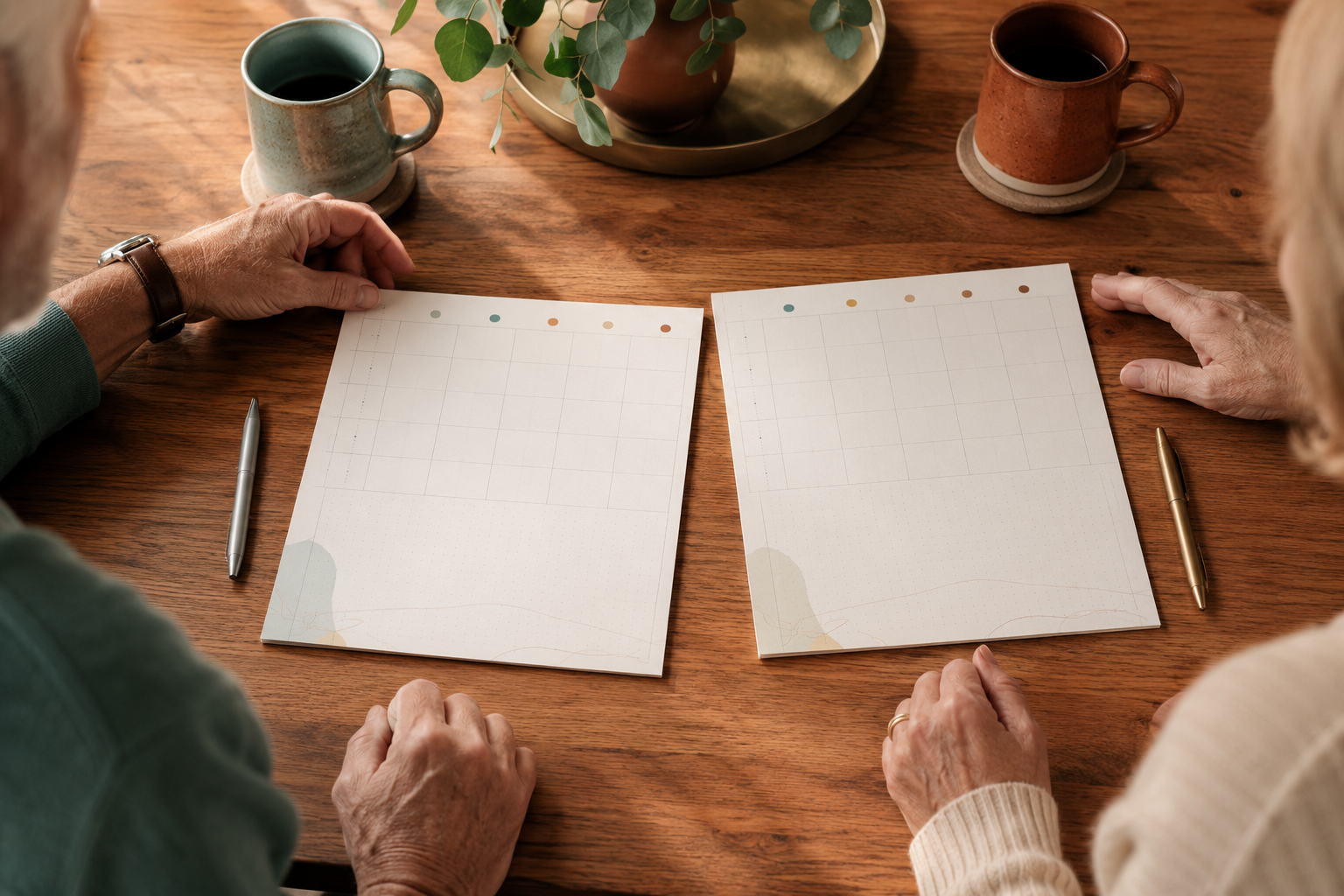
Sketch your ideal ordinary weeks separately first. The differences can reveal the conversations worth having.
How important is travel?
“We'll travel more” is one of the most common retirement ambitions. But “travel” can mean very different things.
One person may picture:
Several long overseas trips every year
Cruises
Extended stays
Spontaneous travel
The other may prefer:
Shorter trips
Returning home frequently
Domestic travel
Spending more time in familiar places
Other questions may emerge:
How much of our retirement budget do we want to spend on travel?
Do we both want the same pace?
What happens if one person becomes less interested in travelling?
Are we comfortable travelling separately sometimes?
These conversations are much easier before bookings and expectations have been made.
Where do we want to live?
Retirement often brings major decisions about home.
Downsize?Move to the coast?Move closer to children?Stay exactly where you are?Buy somewhere smaller and travel more?Move overseas?
One person may have a clear dream while the other is much less certain. Instead of beginning with property listings, begin with everyday life.
Who do we want nearby?
What services matter?
How much maintenance do we want?
What does each of us value about where we live now?
What would we miss if we moved?
What are we hoping a new place will give us?
Does the move solve a real problem - or simply represent ‘retirement’ in our imagination?
A beautiful place is not automatically a good retirement life. It has to work for both people on an ordinary day.
Money can still mean different things even when the finances are sound
NEXTFUL does not provide financial advice, but money has a life side as well as a financial side.
Couples can be financially prepared and still have different attitudes towards spending.
One person may think: “We've saved for decades. Now is the time to enjoy it.”
The other may think: “We need to be careful because we don't know how long retirement will last.”
Those differences can influence:
Travel
Housing
Helping family
Hobbies
Vehicles
Dining out
Home improvements
Experiences
The useful conversation is not only: “Can we afford this?”
What do we each want our money to make possible?
That is a lifestyle question as much as a financial one.
You do not have to agree on everything
This may be the most important point. A successful retirement does not require two people to want exactly the same things.
Have different hobbies
Keep different friendships
Travel separately sometimes
Have different daily rhythms
Want different amounts of social contact
Value different kinds of activity
The goal is not identical preferences. The goal is enough understanding that both people's needs have room.
What will we do together, and what will each of us do independently?
That can be a much healthier question.
Try the two-week exercise
Here is one simple conversation worth having.
Separately, each of you sketches your ideal ordinary retirement week. Do not discuss it first.
Include:
Exercise
Social time
Hobbies
Family
Time together
Time alone
Work or volunteering
Household responsibilities
Rest
Anything else that matters
Then compare your two weeks. Do not immediately negotiate. First, notice.
Where are you similar?Where are you different?What surprises you?What were you assuming the other person wanted?
Which differences actually matter enough for us to talk about now?
This can reveal more than a general conversation about “what retirement will be like”.
Some useful questions to ask each other
What are you most looking forward to about retirement?
What are you most concerned about?
How much time do you imagine us spending together?
What do you want to keep doing independently?
Do you want to keep working in some form?
How much travel do you want?
How involved do you want to be with family?
What would an enjoyable ordinary week look like?
Would you ever want to move?
What do you want our home life to feel like?
What parts of our current life do you definitely want to keep?
What do you hope will change?
What do you need from me during the transition?
You do not need to work through the whole list in one evening.
This is not a meeting. It is a conversation you can return to.
The aim is not certainty. It is understanding.
Retirement plans will change. Health changes. Family circumstances change. Interests change. People discover things about retirement they could not have known beforehand.
That is why the goal is not to create a fixed agreement for the next 25 years. It is to understand each other's expectations well enough to adapt together.
Sometimes simply knowing, “This matters more to my partner than I realised,” can prevent a great deal of misunderstanding later.
Relationships are one part of the retirement-life picture
Relationships are one of the seven dimensions explored in the free NEXTFUL Retirement Life Score™:
01Purpose
02Identity Beyond Work
03Time & Structure
04People & Connection
05Relationships
06Place & Lifestyle
07Possibility & Growth
The Score helps you see where retirement life already feels clear and where a little more discussion or exploration may be useful.
It does not tell you what your retirement should look like. And it does not provide relationship or financial advice.
It simply helps make the questions worth discussing easier to see.
You may both want retirement. The useful question is whether you have talked about the retirement each of you is imagining.